




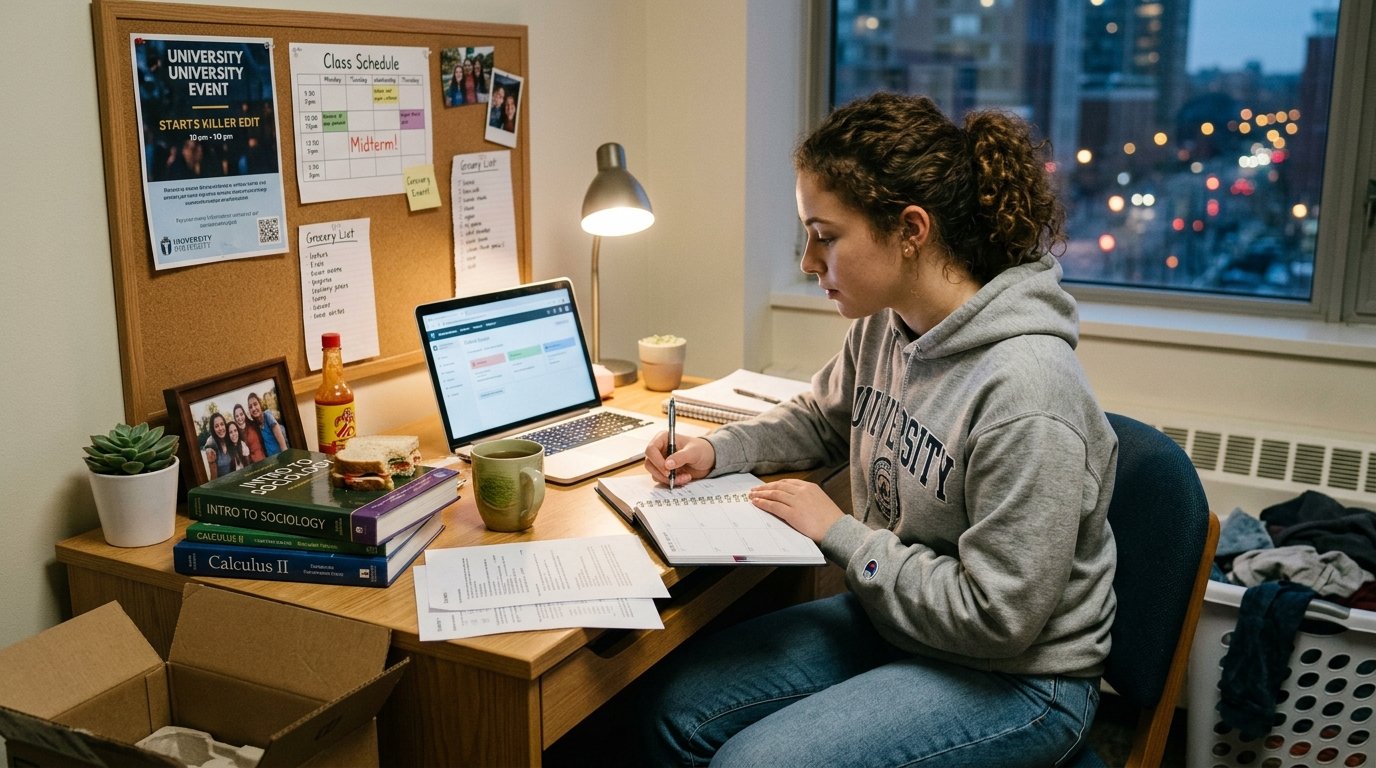
The first year of college doesn’t result in students failing because the coursework is overwhelmingly difficult. It causes failure because nobody tells you that for the first time in your life, you will be expected to simultaneously manage a household and earn a degree, and you have less structure than you’ve ever had before.
The Free Time Illusion
High school gives you about 30 hours of structured time per week, with that number dropping to about half in college. It may look like freedom, but you need those unstructured hours to revise and prep for exams. Map out your week and block out the times you’ll be working.
Why Domestic Tasks Hit Harder Than Expected
Not a single one of the orientation sessions thought to mention that basic life functions like cooking, cleaning, shopping, administrative bill-paying, and simple habitability are also a draw on the study-requiring portion of your brain, and therefore should be kept to an absolute minimum while you’re adjusting to 18 hours a week of independent reading. It’s not an issue of willpower, you just don’t want to use up the last of your energy reserves choosing the figs over the nashi pears.
Not knowing this, you will optimistically set aside an hour a day for reading and make excellent progress on that first reading list before running short on underwear or condiments, and finding that your morning’s study prep-time is eaten up by the hunt for clean jeans or the fact that all the pepper has gone into the carbonara and Craig left the Tupperware in the sink for the third time this week.
The more structural fix is choosing your living situation deliberately. Opting for all-inclusive student accommodation removes the biggest friction points entirely, meals, utilities, maintenance, so the cognitive load of domestic life doesn’t compete with the cognitive load of adjusting to university-level study. For a lot of students, that trade-off is worth more than it costs.
The Shift From Passive to Active Learning
University doesn’t really favor students who were present in each lecture, it favors students who used what they heard. High school is pretty spoon-fed, from concepts through to when to revise a topic and what the test generally looks like. University is the opposite: here are some loose ideas, go find out more in the readings, come back to me in an assessment and show you understand, not recognise.
That’s a big part of what some people mean when they talk about the “hidden curriculum”, the things uni assumes you knew how to do already. The students who don’t figure this out early keep treating uni like high school, floundering. They read over their notes for hours, wondering why it doesn’t click despite clocking the time. Nailing down notes, questions, verbal explanations, connecting concepts over weeks, these are the sorts of habits where you can expect the most results for your effort.
Build an Academic Buffer Before You Need One
Here is some advice that is rarely taken seriously: Begin your major assignments three weeks before the deadline.
Not because you are a worrier. Because in your first year, socially, you won’t know what’s coming. A group of friends will suddenly gel around you. Events will pop up on weekends you had earmarked for work. A week will disappear. The students who are already halfway through their statistics assignment, and have completed two weeks of research and glanced at the articles, can absorb that. The students who were going to really start that one “next week” cannot.
Start by marking your assessment due dates somewhere you will keep staring at them. Rewrite them in your diary, or paste them up above your desk. Properly write them in. Take your syllabus, mark down each deadline, each hurdle, each presentation, spread them out, and mark how many weeks you’ll need to research, write, and finally revise, on each. This takes about half an hour per unit, and you will never do anything at uni that will be worth more per minute.
Approximately 30% of university students don’t return after their first year, with academic unpreparedness and difficulty adjusting to independent life cited as primary factors. Most of those students weren’t incapable. They were overwhelmed and under-prepared for the structure they’d need to create themselves.
Protect the Spaces Where You Recover
If you allow study anxiety to spread, it can feel overwhelming. However, one effective way to deal with it is to create a physical barrier between where you study and where you relax. If your desk is your study space, then your bed should not be a study space too. Library quiet zones are so effective for concentrated study because they are not associated with chatting or relaxing.
This is not about self-control. It’s about sending a clear message to yourself. The space where you relax should be devoted to relaxation. Socializing, making friends and creating a network of peers, is something you should also plan for and not just squeeze into your free time. Students who establish good connections with peers tend to perform better and feel better about themselves. So, including time for your social life as part of your routine is not being lazy. It’s being healthy.
The first year of college is when you perform at your best if you treat your time and mental health as your most important considerations. Get yourself organized at home, study smarter, and ensure you give yourself some breathing space before you hit your deadlines. The students who do this will not only make it through their first year, but they will be over the starting line of year two before they even realize.